
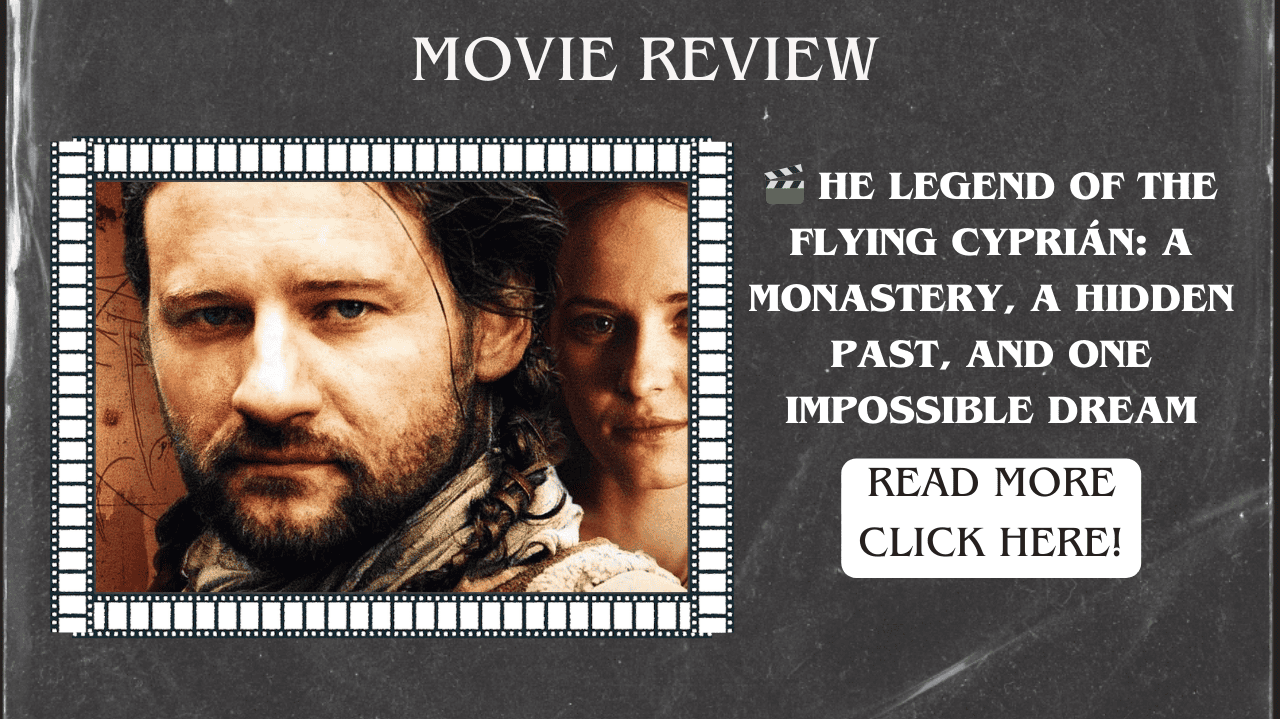
Some films surprise you simply by how cinematic they feel. The Legend of the Flying Cyprián opens with mystery and darkness and pulls you into a magical place called the Red Monastery, where time seems to slow down behind ancient walls. 
And from the very first moment, one question hangs in the air - who is the wounded man the monks find near the gate, half-dead and shot?
When hiding is not the same as redemption
The monks save him and take him in, unaware of the brutal past following him. He has clearly been through hell - and the remote monastery is not only a refuge, but an escape. Slowly he learns herbal healing and begins to quiet the storm inside him. He takes a vow of silence and becomes Cyprián. 
It is a story of a sinner trying to change - but in this film, the past knows how to return. And when it does, the story becomes the most powerful.
Michal, a book signed by da Vinci, and the hunger to fly
Cyprián is accompanied by Michal, a small orphan cared for by the monks. Years pass, and Michal grows into a young man. One day he discovers a book signed by Leonardo da Vinci, filled with designs of flying machines. Suddenly, a new kind of longing enters the monastery - not to run from the past, but to rise above the ground.

Michal secretly builds a machine and attempts to fly, but the experiment fails. He leaves the monastery. Time moves on, monks die or depart, and Cyprián remains alone - with the dream Michal could not complete. And then Cyprián begins to build the flying machine himself.
A film of contradictions - and that may be the point
The film looks surprisingly strong and cinematic, with an effective visual mood. At the same time, it gradually leans into pathos and sentiment - lingering gazes, choral music, and moments that choose atmosphere over strict realism.

But if you accept it as a legend rather than a pure historical reconstruction, it works. You get a visually rich, moody story with a dark, almost fairy-tale spirit - and a lead performance with real charisma.
Interesting facts that add extra depth
-
Cyprián’s Herbarium is said to be preserved today in the collections of the Slovak National Museum’s Natural History Museum in Bratislava. It is considered the oldest surviving herbarium in Slovakia (dated 1766), with sections on herbs and healing methods.
-
Archival notes often mention a chronicle entry about Cyprián’s machine being publicly burned in Spišská Belá. Some versions of the story include a bishop’s order, though the timeline is sometimes questioned because the bishop named in the record may not have been alive at that time.

Who will enjoy it most
-
viewers who love atmosphere - monastery walls, mystery, inner demons
-
fans of redemption stories and the price of peace
-
anyone drawn to legends of flight before flight was possible
You can find the film on Czechmovie.com - with worldwide shipping.
More Czech film stories are coming soon - and if you subscribe to our newsletter, you’ll get them first.


